


Take a bag of potato chips. Not a metaphor. An actual bag, the kind that gets opened on a Tuesday afternoon. That product was cut, fried, seasoned, inspected, weighed to within a few grams of the labeled weight, nitrogen-flushed, sealed, and packed into a shipping carton by equipment running continuously in a facility that processes tens of thousands of pounds of potatoes per day.
None of that happened by hand. Most of it happened faster than a person could observe it clearly.
1. The Conveyor Is the Spine of the Operation
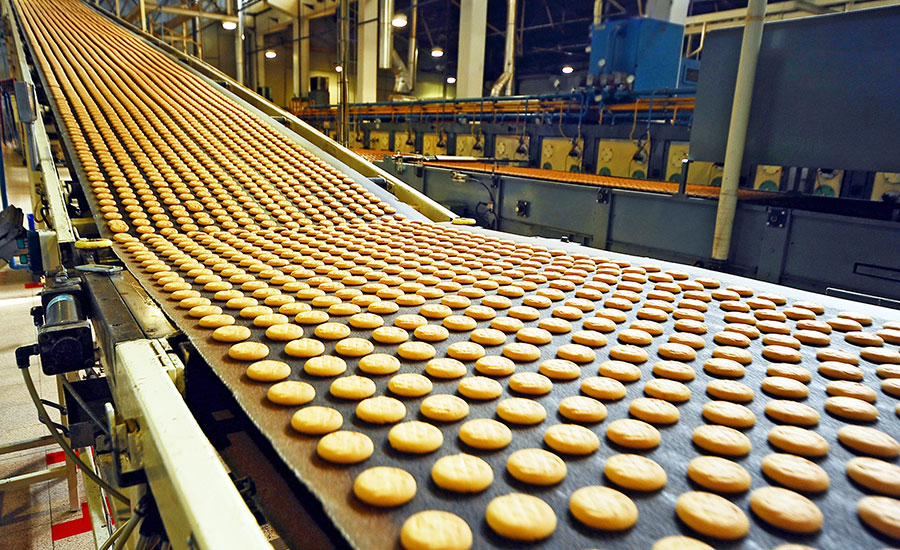
Food processing facilities run on movement. Raw material arrives at one end and finished product leaves at the other, and in between, there are dozens of stations where something specific happens to it. The conveyors connecting those stations are not passive transport. They are calibrated to speed, temperature, incline, and cleanliness standards that are part of the food safety requirement, not afterthoughts.
Food-grade belting is different from industrial belting used in other applications. The material, the surface texture, the join method, all of it chosen for cleanability and compliance with food contact regulations. A conveyor that cannot be adequately sanitized between production runs is a liability in a food facility, regardless of how well it moves product.
2. Cutting, Portioning, and the Tolerance Question
A package labeled four ounces contains four ounces because the cutting and portioning equipment upstream was set to produce exactly that, within a tolerance measured in fractions of a gram. This is not a quality aspiration. It is a labeling law requirement. The industrial equipment supplying and maintaining these systems, companies like Kor-Pak, works in the space where regulatory requirements and mechanical performance intersect. A portioning line that drifts outside tolerance is a product recall in progress. The supply relationship for the components that keep it in tolerance is consequently not a casual one.
3. Temperature and the Race Against Microbiology
Processed food has a temperature-time relationship that the equipment has to manage continuously. A product that sits at the wrong temperature for the wrong duration is a food safety event. The refrigeration, blast freezing, and heat treatment systems running alongside the mechanical processing equipment are not separate systems. They are part of the same production logic.
This is why food processing facility downtime is expensive in a way that is qualitatively different from downtime in other manufacturing. The product on the line is perishable. An hour of downtime can mean an hour of product that cannot be used, rather than an hour of widgets that simply did not get made.
4. Packaging: Where It Either Holds Together or Does Not
Metal detectors scan every unit before shipping. Every unit. Not a sample. Not a random selection. Every package passes through a detector because the consequence of a metal fragment reaching a consumer is not a quality complaint. It is a recall, a regulatory investigation, and potentially something considerably worse.
The sealing equipment has to work correctly at line speed. A seal that fails means a package that is not shelf-stable. The nitrogen flush that extends shelf life has to happen correctly inside a closed package. These final steps are where the entire upstream process either succeeds or becomes expensive waste.
Conclusion
The gap between raw agricultural products and a finished consumer food item is crossed by industrial equipment running continuously under demanding conditions. The food is the visible part. The equipment is the reason it exists at the scale and consistency that fills supermarket shelves.